Oak Alley Plantation Facts & Figures
A quick, sourced reference to Oak Alley Plantation — the dates, numbers and names behind the mansion, the oaks and the estate's history, all in one place.
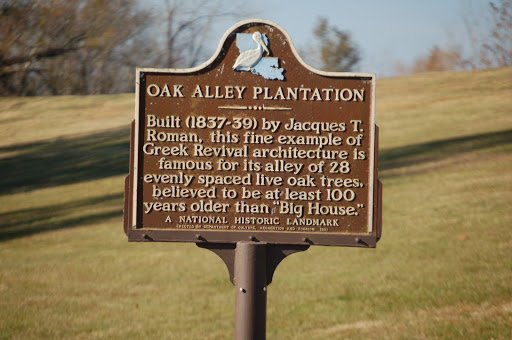
Location & designation
| Location | Vacherie, St. James Parish, Louisiana — west bank of the Mississippi River |
| Address | 3645 Highway 18 (Great River Road), Vacherie, LA 70090 |
| Distance from New Orleans | About 50 miles / roughly 1 hour by road |
| Designation | National Historic Landmark (designated 2 December 1974) |
| National Register of Historic Places | Listed 1974 (reference no. 74002187) |
| Site size | 63-acre historic site (25-acre core in the landmark listing) |
| Governing body | Oak Alley Foundation, a 501(c)(3) non-profit |
| Open to the public since | 1976 |
The mansion
| Original name | Bon Séjour |
| Mansion built | 1837–1839 |
| Architectural style | Greek Revival |
| Design attributed to | Joseph Pilié |
| Columns | 28 colossal Tuscan columns (matching the 28 oaks) |
| Construction | Brick made on site, stuccoed and coloured pale peach; ~70 ft square |
| Built by | Enslaved workers |
The oaks
| The trees | 28 southern live oaks (Quercus virginiana) |
| Approximate age | Around 300 years; planted in the early 1700s (c. 1725–1750) |
| The avenue | About 800 ft — a quarter-mile — from the house to the River Road |
| Planted by | An unknown French colonial settler, roughly a century before the house |
People, sugar & slavery
| Builder and owner | Jacques Thélesphore Roman (brother of Governor André Roman) |
| Owner's wife | Marie Thérèse Célina Pilié Roman |
| Primary crop | Sugarcane |
| Enslaved people | Roughly 110–120 at a time under Roman; close to 200 documented across the plantation's history |
| Agricultural innovation | First successful paper-shell pecan graft, 1846–47, by Antoine, an enslaved gardener |
| Jacques Roman died | 1848 |
| Sold at auction | 1866, for $32,800 |
| Restored by | Andrew & Josephine Stewart (from 1925), architect Richard Koch |
| Last private residents | The Stewarts — ran it as a cattle ranch and reintroduced sugarcane |
| Foundation created | 1966 |
Visiting essentials
| Hours | Daily 8:30am–4:45pm; last admission 4:00pm |
| Big House tours | 9:00am–4:30pm (timed, guided) |
| Closed | New Year's Day, Mardi Gras, Thanksgiving & Christmas |
| Admission at the gate | $27 per adult site-only, or $30 including the guided Big House tour |
| On-site exhibits | Big House, Slavery at Oak Alley, reconstructed cabins, blacksmith shop, Sugarcane Theater |
Sources: figures are drawn from Oak Alley Plantation's official information, the U.S. National Park Service National Historic Landmark listing, and the Louisiana Endowment for the Humanities (64 Parishes). Hours and admission are verified against the plantation's official site and were last checked July 28, 2026. For the full story behind these facts, read the history of Oak Alley Plantation; to plan a trip, see the visiting guide or browse Oak Alley Plantation tours.