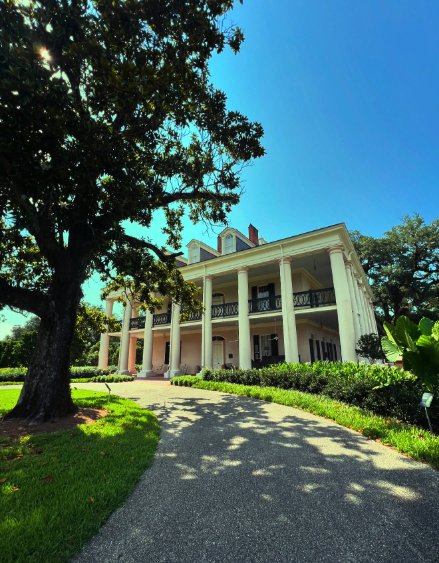
Most visitors arrive at Oak Alley for one image — the quarter-mile of oaks framing the pale-peach mansion — and leave surprised by how much else there is. This is a zone-by-zone walk through the estate, so you know what you're looking at and where to spend your time. For hours and tickets, see our visiting guide; for the full backstory, the history of Oak Alley.
The Alley of Oaks
The avenue that gives the plantation its name is a double row of 28 southern live oaks, around 300 years old, running about 800 feet — a quarter of a mile — from the house toward the river. What surprises people is that the oaks came first: they were planted in the early 1700s, roughly a century before the house, by an unknown settler. The Romans simply built their mansion to line up with the avenue that was already there, and matched its 28 columns to the 28 trees. Walk the full length of it, then turn around: the view back toward the house through the canopy is the one every camera comes for.
The Big House
The 1837–1839 mansion is toured on a timed, guided slot of about half an hour, led by a costumed interpreter. It is a square Greek Revival house, its bricks made on site from Mississippi River clay and its finer materials — glass, slate, marble — shipped in by steamboat. Inside, the guide walks you through the period rooms and the story of the Roman family who built it and the household that ran it. Photography is generally not permitted inside to protect the antiques, so this is the part of the visit to simply take in rather than shoot.
Slavery at Oak Alley
This is the part of the estate that has grown most in recent years, and it is essential rather than optional. In 2013 the Oak Alley Foundation reconstructed cabins in the footprint of the original quarters, and they now house exhibits on the daily lives of the enslaved people — close to 200 individuals documented across the plantation's history — who built the house and worked the sugar. The Foundation also maintains an online slave database. Give this exhibit real time; it is what stops Oak Alley reading as merely a pretty house, and it is where the fuller, harder story of the place is told.
One name to remember: an enslaved gardener known as Antoine grafted the first commercially successful paper-shell pecan here in 1846–47 — an innovation so significant it is named in Oak Alley's National Historic Landmark citation. The skill on the plantation belonged to the enslaved as much as the owners.
The blacksmith shop
Built around the remains of the original forge, the working blacksmith shop is an easy one to walk past and worth not doing so. A plantation this size needed constant ironwork — tools, hardware, repairs — and the shop is a reminder that the estate was a working industrial operation, not just a grand home. On busier days you may find it demonstrated.
The Sugarcane Theater and the grounds
A short film in the Sugarcane Theater explains the crop that made the fortune and demanded the labour — how cane was grown, cut and processed, and how Louisiana came to produce roughly a quarter of the world's cane sugar by the 1850s. Around it, the grounds include formal gardens laid out during the Stewart era, sugarcane still growing on site, and the Stewart family cemetery. It is all self-guided, so you can move at your own pace between your house-tour slot and the exhibits.
The restaurant, gift shop and inn
Practical Oak Alley: there is a restaurant and cafe serving Southern dishes and the well-known mint juleps, a large gift shop where visitors reliably single out the jams and pralines, and clean restrooms. If you want the oak alley to yourself at dawn or dusk, Oak Alley also has an on-site inn — staying over lets you see the avenue without the day-trip crowds, which is the single best way to experience it.
The gardens, the cemetery and the Civil War encampment
The grounds beyond the oaks reward a wander. The formal gardens were laid out during the Stewart era in the 1920s, when Josephine Stewart restored the derelict estate and made it a home again; she and Andrew ran the land as a cattle ranch and later reintroduced sugarcane, this time without enslaved labour, and were the last people to live in the house. Their family cemetery sits on the grounds, the resting place of the estate's last private owners. Elsewhere you may find a Civil War encampment with costumed reenactors explaining how the war's upheaval reached the plantation — a reminder that the estate's story runs well past the antebellum years it is best known for. Antique farm equipment and the sugarcane growing on site fill in the picture of a working agricultural operation rather than a museum frozen in one moment.
Details worth looking for inside
The guided house tour moves at a steady pace, but a few things reward paying attention. The dining room once had a floor of imported Italian marble, part of the effort to impress the guests Celina Roman loved to entertain. The walls are unusually thick, built from those handmade river-clay bricks, which is part of why the interior stays noticeably cooler than the Louisiana air outside — the same principle as the tall windows and the wide central hall, designed to funnel the breeze coming off the oaks. And in the restored rooms, the clocks are stopped at 7:30: the time of Josephine Stewart's death in 1972, a quiet memorial to the last resident, whose 1920s rescue is the reason the house still stands. Ask your guide about the Stewart era as well as the Roman one — the twentieth-century chapter is often the most surprising part of the tour.
How to spend your time
If you have the standard two hours, a good order is: walk the oak alley first while the light is good, take your timed Big House tour, then give the remaining time to the Slavery at Oak Alley exhibit and the grounds, with a stop at the restaurant if you want lunch. If you have three hours — on a small-group tour, or by driving yourself — you can do all of that without rushing. Either way, decide before you arrive that the slavery exhibit is a core part of the visit, not a footnote; it is what makes a day at Oak Alley worth more than the photograph. Ready to plan it? Compare guided Oak Alley Plantation tours with transport and entry included.